Three Ellex intellectual property lawyers have been recognised in the WTR Global Leaders 2026 guide by World Trademark Review. From Estonia, Mari Must and Ants Nõmper, and from Latvia, Mārtiņš Gailis, are included in the WTR Global Leaders: Private Practice ranking.
Published in its eighth edition, WTR Global Leaders brings together leading trademark practitioners from private practice and in-house teams worldwide. The guide draws on World Trademark Review’s research, including the WTR 1000 and WTR 300, to identify individuals considered among the “best of the best” in global trademark practice.
The recognition builds on the firm’s results in the WTR 1000, which highlights leading trademark professionals and firms in individual jurisdictions based on their expertise, market presence and the sophistication of their work.
Earlier this year, the WTR 1000 highlighted Ellex’s IP teams across the Baltics, noting in Estonia the longstanding experience of the team led by Ants Nõmper and commending Mari Must for her strategic trademark work. In Latvia, Mārtiņš Gailis was recognised for his experience in complex disputes and clear strategic approach.
Ellex Lithuania has provided Eur 34,400 in financial support to the Vilnius UniversityLaw Clinic, a non-profit organization that offers free legal assistance to the public. The funding is intended to strengthen the Clinic’s initiatives and projects, which have been operating for nearly three decades.
“This is a highly valuable initiative that not only gives people access to free legal assistance but also helps educate the next generation of legal professionals. We have supported this project since it was founded, recognizing its value in promoting social responsibility within the legal community, giving law students practical experience, and helping people deal with real-life legal challenges,” says Rolandas Valiūnas, Managing Partner at Ellex Lithuania and a member of the Law Clinic’s Board.
The Vilnius University Law Clinic, a public non-profit institution, was founded in 1998 by Ellex in Lithuania, Vilnius University, and the Vilnius University Students’ Representation.
“Interest in the legal services we provide continues to grow. Every year, the Law Clinic assists more than 5,000 people free of charge. Last year alone, we dedicated over 16,000 hours to legal consultations. Those seeking assistance include socially vulnerable individuals, start-up businesses, and non-governmental organizations. This support will enable us to provide legal consultations to even more people who currently need legal assistance,” says Airina Mikulėnaitė, Director of the Law Clinic and a PhD student at Vilnius University.
Free legal consultations at the Law Clinic are provided by senior students of the Vilnius University Faculty of Law. Consultations are available by email, telephone, or in person at the Clinic’s office in Vilnius. The quality of services is ensured by practice group supervisors – experienced legal professionals, attorneys, and academic staff from the Faculty of Law.
The Clinic’s consultants advise clients on dispute resolution, assist with the preparation of legal documents, and provide guidance on matters related to tax, employment, family law, and other legal fields. In addition to delivering primary legal aid, the Clinic actively contributes to public legal education through various initiatives and outreach activities.
Pictured: Airina Mikulėnaitė and Rolandas Valiūnas.
“Today, national security issues are inseparable from business, technology, and the legal environment. By becoming a member of the Association, we aim to contribute to the sustainable development of a sector that is evolving at an exceptional pace, as well as to the creation and implementation of new innovative solutions. By sharing our legal expertise with members of the defence and security sector, we can work together to strengthen the resilience and security of our state,” comments Paulius Gruodis, Partner at Ellex Lithuania.
Membership in the Association will enable Ellex Lithuania to actively participate in discussions and initiatives that contribute to strengthening the defence and security ecosystem, while fostering closer cooperation with businesses, public authorities, and international partners.
Founded in 2014, the Association is a public, non-profit organization that brings together Lithuanian private and state-owned companies, institutions, and organizations operating in the defence and security industry sector.
On April 1, the most extensive set of changes affecting all entities subject to the NILLTPFN came into force. The most significant changes include a new mandatory beneficial owner (UBO) data element, “scope of control,” and a mechanism to restrict public access to UBO data for security reasons. Starting from July 1, the Register of Enterprises (the Register) will record all UBO nationalities, if there are multiple. Below is a detailed overview of the changes.
What specifically is changing?
To fully implement the requirements of Articles 11, 12, 13, and 15 of Directive No. 2024/1640, Article 183of the NILLTPFNL has been amended. The scope of information that must be disclosed in the Register regarding UBO has been expanded. This includes: all nationalities, if there are multiple, as well as the extent of control exercised. Additionally, the UBO gains the right to request that public access to information about themselves be restricted in cases where the disclosure of such information could pose a threat to life, health, or property of the UBO or their family members.
Information Redaction – A New Protection Mechanism
A UBO has the right to submit an application to the Register to have information about them as a UBO designated as restricted-access information. An application may be submitted if the public availability of the information could put this person or their family members at risk of being subjected to a criminal offense and there are objective grounds to believe that this risk could materialize, endangering their:
life;
health;
property.
Upon receiving an application, the Register shall immediately, but no later than within one business day, redact the relevant UBO information without issuing a separate decision. The information shall remain redacted for the duration of the application review – one month from the date of receipt.
Important: The UBO is required to immediately inform the Register if the threat no longer exists. However, if the threat persists, confirmation of its continuation must be submitted once a year.
How does the information redaction process work in practice?
The UBO submits an application to the Register, providing a detailed description of the information and, if available, attaching evidence, confirming the information provided in the application regarding the existing threat. The application may be submitted both upon the registration of a new legal entity and in cases where information about the UBO has already been published.
The Register reviews the application and, if necessary, has the right, but not the obligation, to request the opinion of other authorities regarding the circumstances and the potential realization of the threat. The Register issues a decision, which may be contested – either with the Chief State Notary of the Register or appealed in court in accordance with the procedures set forth in the Administrative Procedure Law. Please note that if the initial decision is in favor of not withholding information and the temporary protection is terminated, then challenging or appealing it does not reinstate the temporary protection.
If the decision is made in favor of withholding the information, it will be withheld both in the section on the UBO of a sole proprietorship or a capital company and in the section where the relevant UBO is listed as an owner or participant (shareholder). Furthermore, if the UBO status arises from indirect ownership rights (indirect participation), the information will be redacted in the sections where the UBO is a member (shareholder) and which relate to that person’s status as a UBO.
It is important to note that the redaction of information applies only to UBO data. It does not apply to information regarding members (shareholders) in capital companies where the specific person is not identified as a UBO. Similarly, the withholding of information does not apply to data registered under another status of the person, for example, as a person authorized to represent a capital company or as the owner of a sole proprietorship.
Updating Nationality Data
Individuals who have been assigned a Latvian personal identification number will not need to submit a separate application to the Register to update information regarding their nationality or nationalities. The current information will be automatically retrieved from the Register of Natural Persons. However, if a Latvian personal identification number has not been assigned, updated information regarding the UBO’s nationality or nationalities must be submitted to the Register by the end of 2026. If the information is not updated within this timeframe, there are currently no penalties applicable.
Scope of control exercised by the UBO – a new data element
Going forward, in addition to information on the type of control exercised, information on the scope of control exercised will also be recorded. How will this work in practice?
The Register already records information on the owners of sole proprietorships, as well as members or shareholders of corporations, including details on the extent of a specific person’s ownership interest. In these cases, the Register will automatically – without making a separate decision – record information regarding the extent of control exercised by the UBO alongside the information on the extent of ownership recorded in the details of owners, members, or shareholders.
In cases where the Register is unable to ensure the automatic recording of such information, the relevant information must be submitted to the Register by the legal entity itself. The information must be submitted as part of the process of updating other information regarding UBO.
On 1 March this year, amendments to the Whistleblowing Act entered into force. The amendments are primarily aimed at addressing practical deficiencies identified three years after the Act came into force.
Previously, the establishment of an internal reporting system was mandatory for undertakings with more than 50 employees. The threshold has now been set at 50 or more employees. While this is technically a minor change, in practice it means that undertakings with exactly 50 employees now fall within the scope of the regulation and must implement an internal reporting system.
The whistleblower contact point functions will be transferred from the State Chancellery to the Corruption Prevention and Combating Bureau (KNAB). KNAB will henceforth also have the authority to verify and supervise compliance with the Act and to issue binding recommendations. Previously, no such active supervisory function existed.
The new wording also prohibits conduct that was not previously explicitly defined: intimidation of a whistleblower, workplace ostracism, causing of losses, and inclusion in informal industry “blacklists”. Importantly, the definition of adverse consequences now also covers threats and attempts to cause such consequences – this broadens the scope of the employer’s liability even where the actual consequences have not yet materialised.
A new Article 16.1 has been introduced: a person who has suffered harm as a result of a knowingly false whistleblowing report will henceforth be entitled to claim compensation. In addition, a monetary penalty may be imposed for bringing an unfounded claim in court against a whistleblower.
The new wording also provides that criminal liability may arise for the unlawful disclosure of a whistleblower’s identity. Previously, no such provision was included in the Act
[2] Equal Pay Act
The Ministry of Welfare has drafted a Pay Transparency Act, which aims to transpose into Latvian law the requirements of the EU Directive on pay transparency. The draft act is currently with the Cabinet of Ministers, where its progress stalled in April 2026. Consequently, it has not yet been approved or submitted to the Saeima for consideration.
The Directive must be transposed by Member States by 7 June 2026. Given the current situation, the act is unlikely to be adopted by the prescribed deadline. At the European level, certain Member States and employer organisations have called for the implementation of the Directive to be postponed or revised; however, the European Commission has made it clear that the transposition deadline of 7 June 2026 will not be extended.
Employers need not wait for the act to be adopted, as the direction of the Directive is clear. Practical steps can already be taken by reviewing remuneration systems, evaluating the criteria to determine remuneration, and implementing measures to ensure that remuneration system is transparent and comprehensible.
Employers can take the following steps now in preparation:
Conduct a remuneration audit across all positions to identify differences in salary, allowances, bonuses, or other work-related payments between equivalent position.
Establish written remuneration criteria based on objective, gender-neutral factors such as qualifications, experience, performance, and level of responsibility.
Organise job categories and ensure comparability, so that each position has a clear remuneration level or range.
Document decision-making related to remuneration, particularly where differences arise between employees in the same position or job category.
Review recruitment and offer process to ensure that remuneration offers are based on a consistent approach rather than individual negotiations.
Establish procedures for handling employee requests for remuneration information and prepare a response mechanism for HR and management.
Train managers and HR specialists to apply equal pay principles consistently and to to justify differences based on objective criteria.
[3] Planned Amendments to the Labour Act
The Saeima (the Parliament) is preparing significant amendments to the Labour Act. The draft act has been adopted at first reading, and the responsible committee is currently preparing it for the second reading, after which it will proceed to a third — and final — reading.
Amendments agreed so far:
Overtime allowances – at least +50% for overtime on a working day; +75% on a public holiday; and +100% for work on a public holiday (non-overtime).
Four-day working week – employers and employees may agree on a four-day working week while maintaining a 40-hour weekly working time (with up to +2 hours per working day).
Delayed salary payment – if salary is not paid for more than two weeks after the due date, the employee may terminate the employment contract with immediate effect.
Idle time regulation – if idle time exceeds 5 working days, remuneration may be reduced to 70% (but not below the minimum salary); if idle time exceeds 4 weeks, the employee may terminate the contract without notice and is entitled to severance pay of at least 75%.
Post-expiry application of collective agreements – if no new collective agreement is concluded within 1 year (rather than the initially proposed 2 years) after expiry, either party may unilaterally withdraw from its application with 6 months’ prior written notice.
Notice period during probation – termination during probation will require 1 day’s notice (currently 3 days).
Outstanding issues:
Dismissal of a trade union member (Article 110) – three differing proposals have been considered: the Minister of Economics’ proposal to delete Article 110 entirely; a proposal by members of the Saeima to limit the trade union consent requirement to authorised trade union officials only (rather than all members). The committee’s position is to “consider jointly” with other proposals, and no final decision has been taken. This remains one of the most significant unresolved issues.
Suspension from work (Article 58) – a proposal to reduce the maximum suspension period from 3 months to 10 working days has been “deferred”, and no final decision has been taken.
When could the act reach the second reading?
Of approximately 60 proposals, about half have been reviewed. More complex issues may be postponed until autumn or even to the next convocation of the Saeima.
Case Law Developments
Judgment of the Senate SKC-2/2026 (29.01.2026) — Non-Compete Clause
The Senate set aside the judgment of the regional court on the basis of the employer’s cassation appeal and remitted the case for a new consideration, while providing guidance on the correct interpretation of a breach of a non-compete clause.
Key findings:
Purpose – the risk of information misuse, not competition as such. The clause protects not against the former employee working for a competitor per se, but against the risk that the employee may use the employer’s protected information for the competitor’s benefit – for example, client data, pricing, strategies, and trade secrets.
A credible likelihood is sufficient. In such disputes, there is no need to prove that the employee actually used the information, which in practice would be disproportionately complex. It is sufficient to demonstrate that the employee could have used the information in the new position.
“Scope of activity” is to be determined by functions, not job title. The regional court compared job titles and occupational classification codes, but the Senate rejected this approach as incorrect. The scope of a non-compete clause must be assessed by reference to the actual functions performed, irrespective of the title, and it is not necessary for all job duties to coincide.
Specification of the protected information is a mandatory requirement in such disputes. General references to “confidential information” are insufficient. When bringing a claim against a former employee, the specific information must be identified and it must be substantiated why it meets the requirements of Article 2 of the Trade Secret Protection Act.
Practical significance: A non-compete agreement is only as strong as the precision with which it is drafted and applied. It is recommended that confidential information, including trade secrets, be specifically listed in the employment contract or an annex thereto, and that the employee’s acknowledgement of having familiarised themselves with it be obtained.
Judgment of the Senate SKC-53/2026 (09.04.2026) – Termination of the Employment Contract in the Event of Prolonged Incapacity for Work
The Senate set aside the judgment of the regional court in connection with the employer’s cassation appeal and remitted the case for a new consideration, clarifying the employer’s right to issue a new notice of termination while the previous one is still in effect. In the case at hand, the employer had terminated the employment contract on the grounds of a reduction in the number of employees, and subsequently, while the notice period was still running, issued a further notice of termination on the grounds of the employee’s prolonged incapacity for work.
Key findings:
Two independent notices of termination may be issued. If the notice period of the first termination has not yet expired but new circumstances, independent of the first, have arisen, the employer may issue a second independent notice of termination on a new ground. The first notice need not be withdrawn, and both notices may exist in parallel. The Senate had already affirmed this approach in earlier case law, and this judgment reinforces it.
The withdrawal procedure (Article 103(3) of the Labour Act) is not applicable here. This provision protects the employee only where the employer wishes to withdraw the notice and continue the employment relationship. If the employer does not wish to continue the employment relationship at all, but merely changes the ground for termination to a new one, the rules on the withdrawal of a notice of termination do not apply.
The employee’s right to “freeze” the notice period has its limits. The employee may request that the period of incapacity for work not be counted towards the notice period, but only insofar as this does not block the employer’s right to terminate the employment contract on the grounds of prolonged incapacity for work (Article 101(1)(11) of the Labour Act). If the incapacity exceeds six months, the employer may rely on this ground irrespective of the employee’s request.
Practical significance: The Senate clarified that an employee’s prolonged incapacity for work arising immediately after the issuance of a notice of termination does not preclude the employer from exercising the right to terminate the employment contract on a different ground. This finding is also applicable to other grounds for termination of the employment contract.
For the second consecutive year, Ellex in Latvia is pleased to support the Vija Celmins Foundation Visual Arts Grant – an initiative that provides opportunities to foster creative exploration and professional development within Latvia’s contemporary art scene.
In cooperation with the Latvian National Museum of Art, a grant of USD 30,000 will be awarded to one Latvian artist or artist collective. The grant aims to support the creative process, encourage the development of new ideas, and contribute to long-term professional growth.
Applications are open from 20 May to 30 June 2026.
We encourage Latvian artists to take advantage of this opportunity and apply.
More information about the application process and eligibility requirements is available HERE!
Baltic Fintech Days, one of the Baltics’ largest fintech conferences, brought together industry experts, investors and companies in Riga to discuss the future of financial innovation in the region. With over 100 speakers, 65 sessions and a broad range of international participants, the event once again underscored the Baltics’ strong position on the European fintech map.
The Baltics continue to stand out internationally by combining world‑class technical talent with relatively agile regulatory frameworks. This has enabled the region to punch above its weight and build a strong reputation for fintech innovation.
According to Kevin Gerretz, Head of Financial Regulation at Ellex in Estonia, the Baltic fintech story remains a compelling one. At the same time, the internal balance within the region is evolving.
“Lithuania’s sustained success in building an international fintech hub and Latvia’s recent momentum – including its early positioning in the MiCA regulatory space – were clearly visible both in the content and the representation at the event,” Gerretz noted.
From an Estonian perspective, one aspect stood out in particular: the relatively limited visibility of Estonian participants among both speakers and attendees.
“Considering Estonia’s longstanding role as a digital pioneer, this is a gap worth addressing more proactively,” Gerretz added.
These developments point to a broader shift in the regional fintech landscape. While the overall quality of the ecosystem remains high, the Baltics are entering a more competitive and differentiated phase of fintech development, where visibility, positioning and regulatory choices are becoming increasingly important.
Ellex continues to advise clients across the Baltics on navigating complex financial regulatory frameworks and adapting to an increasingly dynamic and competitive fintech environment.
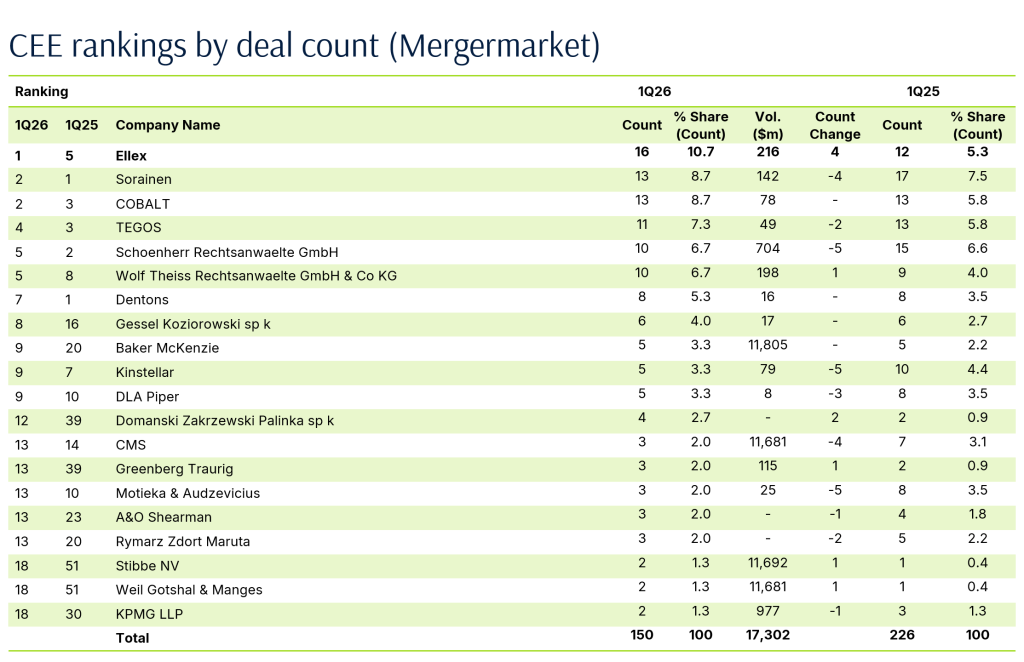
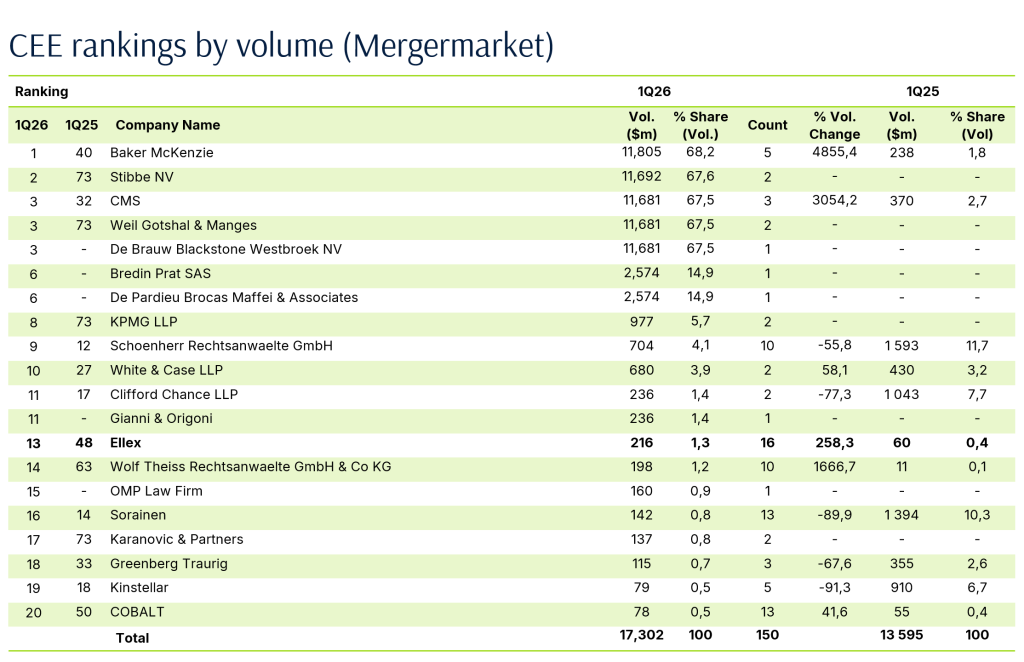
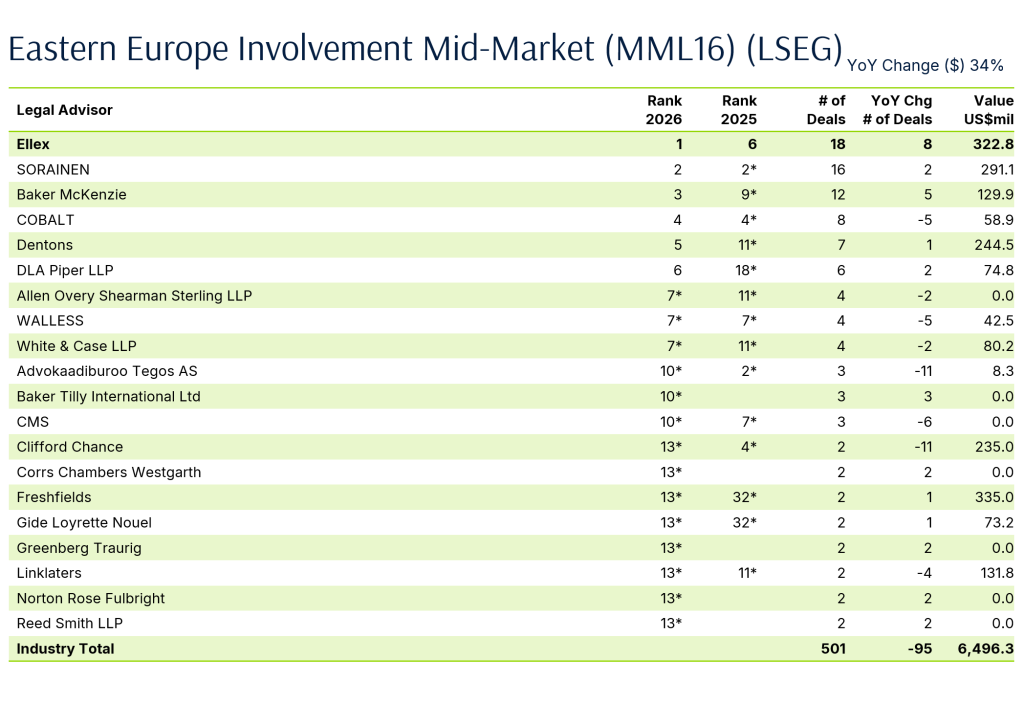
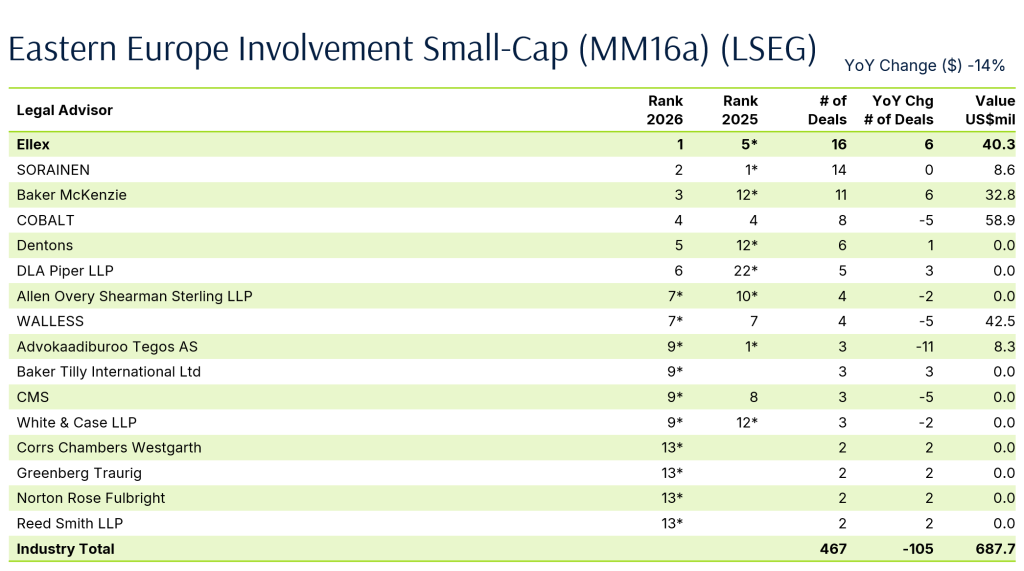
According to transaction market data providers Mergermarket and LSEG, Ellex had a strong start to 2026, ranking #1 by deal count in Central and Eastern Europe in Q1.
In a selective M&A market, Ellex ranked #1 by deal count in Central and Eastern Europe, advising on 16 announced transactions during the quarter. This represents 10.7% of all reported CEE deals, with an aggregate disclosed value of USD 216m.
These results were achieved across a broad mix of mandates, reflecting steady client activity rather than reliance on a small number of headline deals.
Ellex was also the highest‑ranked Baltic law firm in the Nordic and European involvement tables in LSEG’s Small‑Cap and Mid‑Market rankings for the quarter.
We are grateful to our clients for the trust they placed in us during the quarter, and for involving us in transactions that matter to their businesses.
Q1 results at a glance (CEE)
#1 in CEE by number of deals
16 announced transactions
10.7% market share by deal count
USD 216m disclosed deal value
Ellex’s Q1 activity reflects ongoing client engagement across the Baltics, spanning multiple sectors, deal sizes and ownership structures.
Mergermarket is a leading business intelligence and news service specializing in forward-looking mergers and acquisitions (M&A) intelligence, predictive analytics, and corporate data. Mergermarket’s Global and Regional M&A Rankings 1Q26 are available for download here.
LSEG is one of the world’s leading providers of financial markets infrastructure and delivers financial data, analytics, news and index products to 44,000+ customers in over 170 countries.
Under Lithuanian law, foreign direct investments (FDI) that may affect national security – particularly in key sectors such as energy, transport, IT, finance and defence, as well as in strategic companies and infrastructure – are subject to a screening process. Approval is required prior to completing a transaction, and non-compliance may result in the investment being declared invalid or in the loss of shareholder rights.
Investors from EU, NATO, EFTA and OECD countries generally face less stringent scrutiny, while others may be subject to stricter review.
The article examines the scope and duration of this process. Ellex in Lithuania lawyers also note that Lithuania may expand its screening regime to include agriculture and food sectors, reflecting increased attention to supply chain security.
The W&C FDI Reviews 2026 publication provides a perspective on an increasingly complex and fast-evolving investment landscape across jurisdictions worldwide.
The latest edition of the international GAR 100 ranking has been released, marking the third consecutive year the Ellex arbitration team has been listed among the world’s best.
The GAR 100 is an annual ranking compiled by the international arbitration directory Global Arbitration Review, listing the world’s leading arbitration practices.
The Ellex arbitration team is one of the largest in the Baltic region and among the most experienced in handling complex commercial and investment arbitration cases. The team consists of 23 experts with extensive experience in representing investment disputes, as well as acting for clients in various commercial arbitration proceedings before major international arbitral institutions.
Firms are selected for the GAR 100 based on their arbitration teams’ outstanding expertise and strong reputation, as well as their most significant cases, achieved results and overall contribution to the development of international arbitration practice.
Launched in 2006, GAR is the leading resource for international arbitration news and community intelligence, providing high-quality analysis of elite firms worldwide. Each year GAR publishes unique survey: the GAR 100, a guide to specialist arbitration firms worldwide. The survey points readers to dependable counsel, offering extensive qualitative analysis of arbitration practices around the world. Firms are stringently researched and assessed to ensure that only the elite are listed.
Rūta Karpičiūtė, Partner at Ellex Lithuania, has been awarded the Lexology Index 2026 Client Choice award. She was recognised as the winner in the Healthcare & Life Sciences category and is the only recipient of this distinction in Lithuania.
This recognition reflects her long-standing commitment to delivering outstanding client service. Rūta has been consistently recognised by Lexology Index (formerly Who’s Who Legal) for nearly two decades, since 2007.
What makes this recognition even more meaningful is that it is based entirely on client feedback. Unlike many other legal rankings, it is not driven by peer review or submissions from law firms, but by nominations from corporate counsel. Thus, the award places a strong emphasis on service excellence – recognising not only professional reputation or deal size, but also how clients experience working with their legal advisers.
The awaited Legal 500 Europe, Middle East & Africa (EMEA) 2026 edition has once again recognised Ellex among the leading law firms in the Baltic region, reaffirming its position as a top-tier legal advisor across key practice areas.
This year, Ellex has achieved an exceptional number of Tier 1 rankings across Estonia, Latvia, and Lithuania, demonstrating consistent excellence and strength across the full-service offering.
Ellex offices in Estonia, Latvia, and Lithuania have been ranked Tier 1 in the following practice areas:
Banking, finance and capital markets;
Commercial, corporate and M&A;
Dispute resolution;
EU and competition;
IP, IT and telecoms / Intellectual property;
Real estate and construction;
Shipping and transport.
Additional Tier 1 recognitions include Employment (Latvia & Lithuania), and in Lithuania also Fintech, Projects & energy, and TMT (Technology, Media & Telecommunications). Tier 2 rankings in Tax across all three Baltic countries and Employment in Estonia. Our experts have received individual recognitions across key categories, including 14 Hall of Fame rankings, 23 Leading Partners, 17 Next Generation Partners, and 14 Leading Associates.
Our performance across the Baltics has remained stable and strong, and we see these results as an encouragement to keep doing what matters most – working closely with clients, gaining the perspective that helps us see further, and supporting them in navigating both today’s decisions and tomorrow’s challenges.
For over three decades, The Legal 500 has been analysing the capabilities of law firms worldwide, with a comprehensive research programme that is updated annually to provide the most current and in-depth view of the global legal landscape. The directory assesses the strengths of law firms in more than 150 jurisdictions.
Chambers & Partners has published the Chambers Europe Guide 2026, once again recognising Ellex as one of the leading law firms across the Baltics. The latest results highlight our focus on delivering strategic and client-focused legal solutions and reflects the high level of trust our clients place in our pan-Baltic team.
According to the rankings announced on March 19th, Ellex has maintained its Band 1 position in Dispute Resolution across all Baltic jurisdictions. Ellex have also been ranked as Band 1 for Corporate/Commercial (Estonia, Lithuania), Competition/Antitrust (Latvia, Lithuania), Banking & Finance (Estonia, Lithuania), Employment (Latvia, Lithuania), Intellectual Property (Estonia), and Real Estate (Estonia, Latvia).
This year, 65 Ellex professionals were ranked across 8 practice areas. Notably, 5 of our experts were honored with the highest individual distinctions: Filips Kļaviņš nominated as Senior Statespeople (Corporate/Commercial), Jevgēnijs Salims – Senior Statespeople (Dispute Resolution), Valentinas Mikelėnas – Senior Statespeople (Dispute Resolution), Giedrius Stasevičius – Senior Statespeople (Banking & Finance), Rolandas Valiūnas – Eminent Practitioner (Corporate/Commercial).
The Chambers Europe Guide is one of the most prestigious benchmarks in the legal industry, providing an objective analysis of law firms across the continent. These rankings are the summary of independent research, including interviews with clients and peers.
Ellex has maintained its presence in these rankings for two decades. For us, consistently being ranked at the top is not only a reflection of past achievements, but also a proof of our ongoing ambition to set the pace for legal innovation and client-focused excellence in the Baltics.
You may explore the full Chambers Europe Legal Guide 2026 here.
As of 9 March, Kevin Gerretz, senior associate, takes on the role of Head of Financial Regulatory at Ellex in Estonia. His work focuses on financial services regulation, anti-money laundering and counter-terrorist financing requirements, and capital markets. Kevin advises clients on complex regulatory matters, helping them navigate decisions that are informed, carefully balanced, and business‑oriented.
Extensive experience across the financial regulatory landscape
Kevin has a long-standing experience interpreting financial services and product regulation, compliance obligations and requirements applicable to market participants. His advisory practice covers financial products, services and critical financial infrastructure. He has assisted clients in areas including:
investment services and products;
credit provision and banking;
payment services;
securities market infrastructure, including central securities depositories and trading venues;
anti-money laundering and counter-terrorist financing measures, as well as international sanctions.
Kevin also has substantial experience representing clients in supervisory and licensing proceedings and in interactions with regulatory authorities, including situations where regulatory issues directly affect clients’ operational possibilities.
Key role in capital markets transactions
Alongside regulatory work, Kevin has broad experience in capital markets. He has advised on numerous debt and equity offerings and has participated in the issuance and admission-to-trading processes for a wide range of instruments.
Leadership and commitment to develop the next generation
Kevin leads the financial regulatory team at Ellex in Estonia and is actively involved in mentoring junior colleagues and interns. He values creating opportunities for younger lawyers to work on substantive matters and take responsibility early, strengthening both their professional growth and the long-term sustainability of the team.
Balancing detail and the bigger picture
Kevin emphasises that the highly regulated nature of the financial sector requires a precise understanding of detailed rules as well as the ability to see the broader context. Striking the right balance between risk-based compliance and business opportunity is essential, and central to the advice he provides.
Five deals advised by Ellex team have been shortlisted for the 2025 CEE Legal Matters Deal of the Year Awards. Organised by CEE Legal Matters, a leading legal industry publication covering Central and Eastern Europe (CEE), the awards, including shortlist, highlights transactions with major regional impact – from defence financing and renewable energy to cross‑border tech acquisitions and strategic infrastructure projects.
The shortlisted Ellex-advised deals in the Baltics:
Valstybės investicinis kapitalas’ UAB EUR 25 million bond issue, the first in the Nordic and Baltic markets to be listed under the Nasdaq European Defence, Resilience, and Infrastructure (NDRI) framework, specifically to finance the Rheinmetall ammunition factory and other Lithuania’s national security initiatives.
Eesti Energia’s voluntary takeover offer, squeeze-out of minority shareholders, and delisting of Enefit Green AS from the Nasdaq Tallinn Stock Exchange.
The divestment of 100% of the shares in security technology company Defendec Holding OÜ and its Estonian, UK and US subsidiaries to VOSKER, a Montreal-based provider of advanced surveillance solutions.
EUR 85.6 million financing from EBRD, NIB and Edmond de Rothschild AM to Baltic Storage Platform for Estonian BESS Projects.
Advising the lender on the Tele2 – Global Communications Infrastructure (GCI) 50/50 joint venture establishing a pan‑Baltic tower infrastructure company.
The Deals of the Year Awards this year received 301 submissions and a total of 253 deals are eligible for one or (in some cases) multiple awards this year.
The winners of the 2025 Deals of the Year award will be announced in May.