Lithuania’s COVID-19 test case: ECHR rules against excessive profits in public procurements

Evelina

A few years ago, during the global COVID-19 pandemic, it was common to see public outrage over the skyrocketing prices of protective masks, disposable gloves, or disinfectants—items that had increased in price by several or even dozens of times compared to pre-pandemic periods. Soon after came the stories of public procurements, where the government, with no other choice, was forced to spend millions on masks, rapid tests, vaccines, and more. At that time, businesses and society were divided into camps: some argued that businesses have the right to make a profit, while others insisted that there must be limits to everything. This led to legal proceedings. One high-profile Lithuanian case, in which a business and the state argued over nearly €4 million for COVID-19 tests, was recently concluded at the European Court of Human Rights (ECHR).

So, is the right to have a profit is absolute? Is it fair for a business to take advantage of the COVID-19 pandemic to profit? Matas Malijonis, a senior associate at the law firm “Ellex Valiunas,” shares more insights on the matter.


Courts Are Changing Their Approach to Businesses Participating in Public Procurements

It is commonly believed that businesses participating in public procurements have only rights, while all responsibilities and negative consequences of flawed procurement processes fall solely on the buyer—the government, its institutions, and agencies.

For example, if buyers accept the offer of a supplier who has provided false information and unjustifiably conclude a procurement contract with him, it is the buyers who bear the costs of fines (as well as covering the other party’s legal expenses, etc.). Meanwhile, the supplier, having used less-than-honest methods to win the procurement, often escapes unpunished.

However, this perception of impunity for businesses participating in public procurements was challenged by a prosecutor defending the public interest. The European Court of Human Rights ultimately ruled that businesses cannot exploit the COVID-19 pandemic to offer goods, services, or works at unreasonably high-profit margins.


What Matters More—The Right to Profit or the Public Interest?

The story dates back to the early days of the COVID-19 pandemic when the government urgently needed to acquire rapid COVID-19 tests. Businesses capable of supplying them understood they were operating in a high-demand, low-supply environment, which allowed them to sell these tests at substantial profit margins. The government has also approached procurement processes with less formality than usual due to the crisis.

Two public procurement contracts were signed with two suppliers under non-competitive conditions. As later determined by Lithuania’s Supreme Court in a case initiated by a prosecutor defending the public interest, these suppliers earned €145,200 and €3,997,400 in excess profits during the execution of the contracts. They were ultimately required by the court to return these “superprofits” to the government budget, which they did.

In other words, the court defended the state’s interest and, by interfering in the contractual legal relations between the state and business, cut off a significant part of the profit margins of entrepreneurs. The question therefore arose whether regulating the profit margin of businesses by judicial instruments after they have already won an organized public procurement and concluded a public procurement contract does not conflict with the legitimate expectations of businesses to make a profit in their activities.

As all possibilities to defend the right of business to profit in Lithuania have been exploited, the matter has now been addressed to the European Court of Human Rights.


ECHR: The Right to Profit Does Not Extend to Vendors Exploiting the State’s Crisis

The suppliers argued before the ECHR that their right to property guaranteed by the Convention for the Protection of Human Rights and Fundamental Freedoms had been violated by the national courts, which ordered them to return the “excess profits” they had received.

In its judgment, the ECHR found that the right to make a profit is in principle not protected in cases where suppliers, aware of the scale and extent of the government’s distress, and in the context of a less than transparent procurement procedure, offer prices that are not economically justifiable, and apply extremely high-profit margins.

In other words, the ECHR agreed with the Lithuanian Supreme Court when it said that businesses participating in less than the most transparent public procurement procedure must also bear the potential negative consequences of such a process.


What Does This Change?

This ECHR ruling reflects a shift in the general approach to suppliers and their accountability in public procurement procedures—a trend that has also been observed in previous rulings by the Court of Justice of the European Union and the Lithuanian Supreme Court.

The era of supplier impunity is gradually giving way to an understanding that suppliers, too, must take responsibility for the negative outcomes of non-transparent, non-competitive public procurement practices.

It is likely that in the future, we will see more cases where suppliers are held accountable for dishonest actions in public procurement processes.

 

Anneli Krunks

Ellex in Estonia appoints Anneli Krunks as Head of FinTech

Anet Maripuu

Starting January 1, 2025, Ellex in Estonia will have its own Head of the Fintech practiceAnneli Krunks. 

Anneli has more than 10 years of experience advising clients on regulatory matters concerning banking, financial law, and especially FinTech sector. She is a well-known and respected expert in the market, with recognition extending beyond Estonia. Over the years, Anneli has consistently contributed to the development and work of the firm’s FinTech practice. Ellex remains the only law firm in Estonia with a specialised team dedicated to advising FinTech companies. According to international directories, Ellex in Estonia has been the top choice for clients. Under Anneli’s leadership, the practice is set to achieve stronger strategic growth and enhanced capabilities to deliver top-quality legal assistance in rapidly evolving areas. 

The continuous development of technology in the financial sector and the resulting growth of the FinTech market require a more specific focus on this sector. By appointing a dedicated Head of FinTech, we are further strengthening our commitment to developing financial innovation as a standalone business area, providing technology-driven financial institutions and providers of innovative financial services the best legal advice on the market. 

The steady introduction of new regulations in the financial sector will continue through 2025 and beyond. Financial sector technology is evolving at an incredibly fast pace. The past decade has brought new demands by the clients for the financial service providers as well as to the understanding what financial services are . The market continues to introduce new, increasingly innovative solutions. Technological advancements lead to more specific rules, and high-quality legal advisors must have strong industry-specific expertise and an openness to change – essentially staying one step ahead of current regulations. Our challenge as legal advisors in 2025 is to swiftly and effectively navigate new and innovative solutions and help integrate them into an evolving legal framework,” said the newly appointed Head of FinTech, Anneli Krunks. 


Latest updates from the sector:

Corporate income tax in 2025: purchasing or renting less environmentally friendly cars will cost more

Evelina

Sustainability and Taxes—two words that can send shivers down the spine of some business leaders. However, in a move to encourage companies to adopt more sustainable practices, new amendments to the Law on Corporate Income Tax took an effect on January 1, 2025. These changes increased corporate income tax rate from 15% to 16% and altered the rules for attributing costs related to the purchase and rental of passenger cars to allowable deductions.

According to expert Rūta Švedarauskienė and senior associate Laura Navickė from the law firm Ellex Valiunas, the upcoming changes will widen the gap between financial and tax accounting, increasing the workload for accounting professionals and raising the tax burden for companies that purchase or rent less environmentally friendly cars starting from 2025.

Allowable Deductions for the Purchased Car Will Depend on CO2 Emissions

Until the end of 2024, businesses were able to deduct the full cost of purchasing or renting passenger vehicles. However, as of 1 January 2025, only a portion of the purchase price of a newly purchased car will be eligible for the deduction, depending on its carbon dioxide (CO2) emissions. The lower the emissions, the larger the deductible portion of the cost (or the entire cost, if it does not exceed a specified limit):

  • If CO2 is equal to 0 g/km: allowable deduction is up to €75,000.
  • If CO2 is between 0 g/km and 130 g/km CO2: allowable deduction is up to €50,000.
  • If CO2 is between 130 g/km and 200 g/km CO2: allowable deduction is up to €25,000.
  • If CO2 is above 200 g/km CO2: allowable deduction is up to €10,000.

Additionally, the State Tax Inspectorate clarifies that the non-deductible portion of the car’s purchase price shall be gradually allocated to non-deductible expenses over the car’s depreciation period, not all at once.

For instance, if a car emitting 50 g/km CO2 is purchased in January 2025 for €100,000, only €50,000 can be deducted over six years (€8,333 annually), while the remaining €50,000 shall be attributed  to non-deductible expenses proportionately over six years.

Sustainability Becomes Important Even When a Company Rents a Car

The changes will apply not only to the purchase but also to the rental expenses. Starting January 1, 2025, when a company rents a car under a new or extended agreement instead of purchasing it, only a portion of the rental expenses will be deductible each month. This deductible portion will depend on the previously mentioned CO2 emission limits and the depreciation rate applied by the lessee, divided by 12. 

For example, if a company rents a car emitting 150 g/km CO2 under a contract signed after January 1, 2025, and applies a six-year depreciation rate for passenger vehicles, the amount of allowable deductions per month will be €347 (€25,000 (maximum allowable deduction based on CO2 emissions) ÷ 6 years ÷ 12 months). If the monthly rental expenses exceed this amount, the difference shall be attributed to non-deductible expenses for corporate income tax purposes. 

As a result, companies looking to minimize non-deductible expenses and corporate income tax will need to choose passenger vehicles more carefully based on their environmental performance. 

It is important to note that these restrictions will not apply to light goods vehicles (classified as N1) or to vehicles used for rental services, driver training, or transportation services. Furthermore, the restrictions on rental costs will not apply to rental periods of less than 30 days or to agreements made through electronic platforms (e.g., “Bolt” or “CityBee”). 

Challenges in VAT Calculation for Car Purchases

The Law on Corporate Income Tax stipulates that only the portion of non-deductible VAT calculated on the basis of deductible expenses for corporate income tax purposes can be attributed to deductible expenses. Accordingly, if the deductible expense limits for cars are restricted, situations may arise where the VAT calculated on the car’s price cannot be fully allocated to deductible expenses. 

For example, if a car emitting 50 g/km CO2 is purchased for €100,000 plus €21,000 VAT, only the VAT calculated on €50,000 can be treated as allowable deductions, amounting to €10,500. The remaining VAT portion (€10,500) should be classified as a non-deductible expenses in the first year of the car’s purchase. 

Car Sales and Corporate Income Tax

The Law on Corporate Income Tax stipulates that the income from the increase in asset value is calculated as the difference between the asset’s sale price and its acquisition cost. If the asset is subject to depreciation, its acquisition cost is reduced by the amount included in allowable deductions. 

Although it might seem that a company selling a car would have the right to deduct the entire acquisition cost (minus the accumulated depreciation) from the revenue, the position of the State Tax Inspectorate has been that only that part of the purchase price which meets the threshold for allowable deductions will be treated as the purchase price. 

For example, if a company purchases a car with CO2 emissions of 50 g/km for EUR 100 000 and decides to sell it the following month for the same amount of EUR 100 000, it will be considered that the purchase price of the car for corporate tax purposes equals EUR 50 000 and that the profit on the sale equals EUR 50000. 

Business will not always be happy

The change will oblige companies to differentiate the accounting for cars purchased/leased from 2025 onwards, including additional calculations. Accordingly, this will increase time costs and may encourage people to stick to older cars, while forgoing the purchase of newer and greener cars. When these changes to corporate income tax were introduced, it was announced that they would raise (only!) €8 million a year for the state budget. However, these calculations did not consider the additional accounting burden on companies, and it is not clear to what extent the new regulation will actually contribute to the Green Deal objectives 

R. Karpičiūtė: healthy citizens are the next pillar of national security and stability

Evelina

Traditionally, when we think of securing the well-being of our nation, we often think of a strong focus on the defence sector. Of course, a nation’s defence is the most important thing, ensuring the safety and security of its citizens. However, is our traditional understanding of what security really is correct?

Health, which used to be seen mainly in terms of personal well-being, is increasingly recognised as a crucial component of national security and stability. Investing in health systems is not only about providing medical care for the sick, but also about strengthening the very foundations of our society. A strong health system is like a firewall against pandemics, biological threats and the numerous challenges that threaten our global well-being.

Investing in health systems also brings significant economic benefits. Healthy populations are more productive, which leads to economic growth and prosperity. Conversely, neglecting health infrastructure can be very damaging, through lost productivity, higher healthcare costs and lower human capital.

Ideally, priority should be given to investment in health systems, combined with defence spending, thus recognising the complementarity of the two sectors and ensuring overall public security. Integrating health investments into the overall national security investment framework recognises that a state’s stability depends as much on its ability to prevent health crises as it does on managing military threats.

Public-private partnerships are important

It is important to note that public-private partnerships in healthcare can be comparable in importance to defence partnerships. These partnerships contribute to the resilience and sustainability of our health systems. Private sector partnerships often bring innovation, efficiency and management expertise that can significantly improve the delivery of health services. By partnering with private entities, public health systems can benefit from these efficiencies, resulting in more effective and timely delivery of health services.

Public-private partnerships can also mobilise additional financial resources for health care that may not be available when relying on public funding alone. Public-private cooperation in health can therefore help to fill financing gaps, especially in resource-constrained environments, and ensure continued investment in health infrastructure and services.

The biggest influence is the redirection of public investment

The defence sector benefits from long-term strategic planning and preparations. Similar principles can be applied to health systems to effectively predict and reduce emerging health threats.

Investing in healthcare is not only a tool for economic growth, it is also an important factor in ensuring sustainable development. For example, in 2023, cardiovascular diseases were 52% of all causes of death in Lithuania, and oncological diseases 21%. Regional differences are very clear: in rural, non-urban municipalities, mortality from cardiovascular diseases is 37% higher than in urban areas.

The economic losses are also worrying, as cardiovascular diseases cost Lithuania 2.5% of GDP annually, compared to an EU average of 2%. Priority public investment in healthcare would not only reduce the economic losses, but could also catalyse GDP growth by at least 0.5%.

It is disappointing that Lithuania chooses to devote one of the lowest percentages of investment in the EU to the health sector. A study published this year of 38 Organisation for Economic Co-operation and Development (OECD) member countries, looking at data from 1996 to 2020, confirmed the results of previous studies: there is a statistically significant relationship between national health spending and a key health outcome – life expectancy.

National security is multidimensional, encompassing not only military threats but also health threats. The health sector is not only a spending but also an investment – an investment in our country’s resilience, prosperity and security.

Prepared by Rūta Karpičiūtė, Partner at Ellex Valiunas


Atraktiivseim tööandja

Most attractive law firm among law students in 2024

Anet Maripuu

Most attractive law firm among law students – Ellex in Estonia! 

Ellex in Estonia has been recognised as the most attractive employer among law firms in 2024, according to a survey conducted by employer branding agency Instar. The survey, held for 15th year, was carried out nationwide from March to May. Nearly 6,000 respondents participated, sharing their job expectations and opinions on employer reputation. On September 4, during the Attractive Employers Day event, organised by Instar and the Estonian Chamber of Commerce and Industry in Tallinn, the most attractive employers were awarded a prestigious quality label. 

Employers were recognised across nine categories, including the most attractive employers for university and vocational school students, as well as for the general working population. Additionally, the top employers in fields such as economics, IT, engineering, law, medicine, and the humanities were celebrated. The top 5 most attractive employers (out of 301) for law students in 2024 were the Ministry of Justice, Estonian Courts, the Supreme Court of Estonia, the Prosecutor’s Office and only Ellex in Estonia among law firms. 

Triin Tõnsing, HR Manager at Ellex in Estonia, is happy: “Over the past year, we have consciously taken the direction to ensure that students leave with positive emotion and experience. Our trainee programme is versatile, giving students the opportunity to get to know different areas of law, experts, support team and the social life of the firm, while being a valuable team member. From the most recent trainee programme, 4 students are now our employees.” 

Read more about the results of the survey on Instar website. 

Photo by Andrei Ozdoba.

“Kantar Prospera” announces the results of the law firm client survey: Ellex – rated the best

Evelina

Clients today hold Lithuanian business law firms to very high standards, expecting competence and experience with large and international projects, as well as a good firm reputation. These expectations have risen significantly this year. This is confirmed by the annual Kantar Prospera Tier 1 Law Firm Review of Lithuanian law firms for 2024, in which Ellex Valiunas was recognized as the unbeatable leader, both in overall performance and across all individual legal areas.

Ellex Valiunas Managing Partner Rolandas Valiūnas said that leadership today is largely defined by client feedback: “The highest recognition for a law firm, as with any business, is positive client feedback, followed by client recommendations. Ellex has held the top spot in client surveys for several years in a row, but this year is exceptional because clients rated us as absolute leaders by an even greater margin – in many areas, we outperform other law firms almost twice over. I am very proud of the entire Ellex team, which contributes to such a high overall rating through their daily work, and I am happy for our clients, who receive the highest quality services that best meet their needs and expectations,” Valiūnas said.

In recent years, the firm has heavily invested in improving client experience, process and system innovations, including substantial investments in artificial intelligence tools that allow lawyers to spend less time on administrative tasks and focus on client challenges. A significant amount of attention and investment has also been directed towards improving lawyer qualifications, ensuring that lawyers not only understand their professional field but also the specifics of their clients’ businesses, thus maintaining the highest client service standards and offering creative and precise solutions to business problems.

In the Kantar Prospera survey, representatives from companies and organizations evaluate law firms in 14 different categories, as well as professional competencies in specific areas of business law. The overall assessment, which encompasses all these categories, is considered the main measure of evaluation by market players.

The Kantar Prospera Tier 1 Law Firm Review of Lithuanian law firms this year included 119 organizations operating in the Baltic region, each of which spends at least 15,000 EUR annually on legal services. Of those surveyed, 54% were top-level executives, and a third were corporate lawyers and heads of legal departments. The study, based on client surveys, this year included law firms such as Cobalt, Sorainen, TGS Baltic, and Motieka, but clients also commented on firms like Triniti Jurex, Walless, Widen, and Eversheds.

Although there are various law firm rankings, Kantar Prospera Tier 1 Law Firm Review stands out because it offers a much broader perspective and allows for more qualitative insights compared to rankings such as The Legal 500 and Chamber and Partners, whose results are also influenced by firms’ self-submitted applications and subjective evaluator judgments.

Ellex is the largest law firm in the Baltic States and the largest in terms of partner numbers. It is also the number one advisor to foreign investors in the Baltic region, having advised more than 50% of the top 100 foreign investors to date.

Sustainability Reports for Business: how to prepare for the unexpected?

Evelina

Sustainability has become a popular topic in all industries. Investors are also paying close attention to this issue, requiring companies to provide adequate and relevant information on their sustainability performance before making investment decisions.

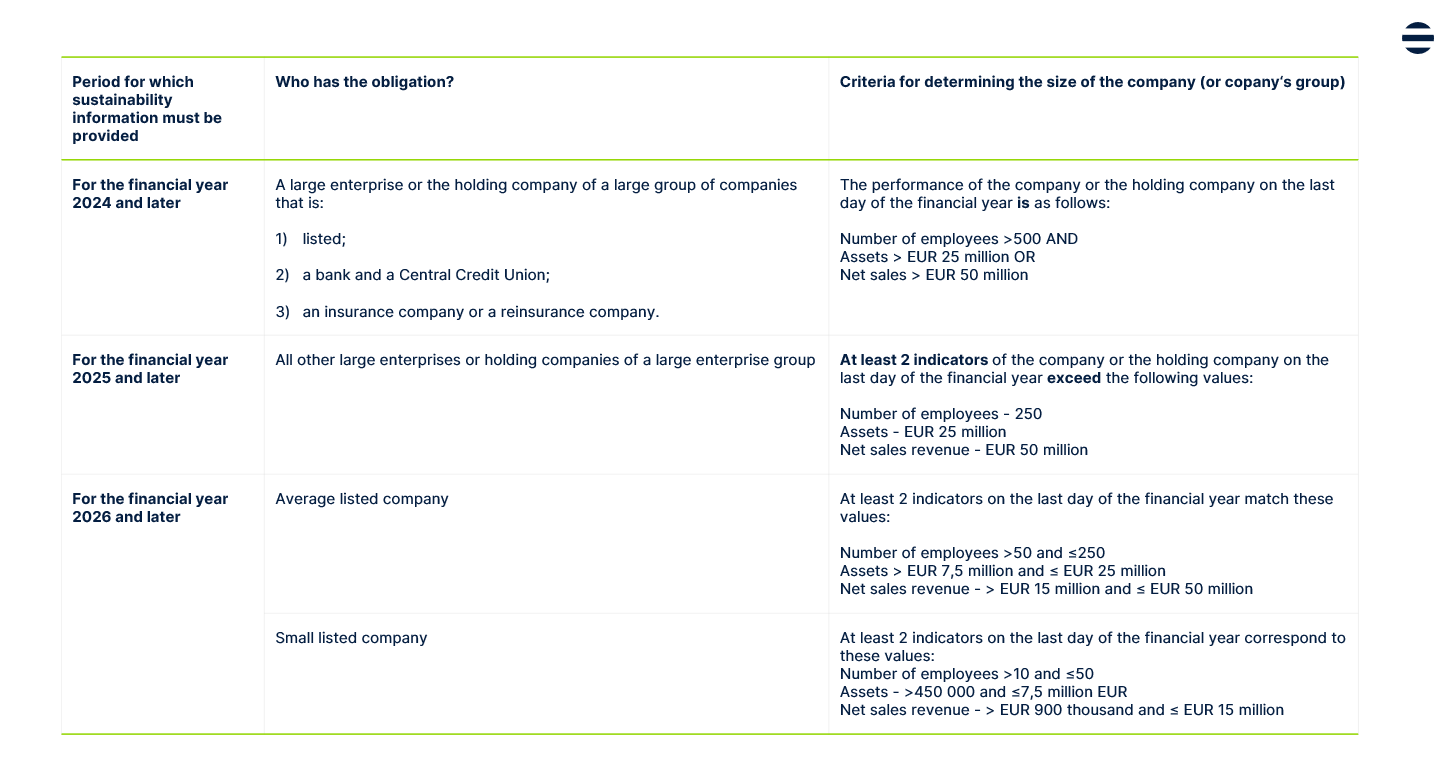
Lithuania, like other EU countries, has started to implement Directive (EU) 2022/2464 of the European Parliament and of the Council, which aims to regulate companies’ provision of sustainability information. From next year onwards, this topic will become relevant for a significant number of companies. If a company has assets of more than €25 million, or sales revenues of more than €50 million, or has more than 250 employees – two of the three requirements – will require the preparation and submission of sustainability reports. Rūta Armonė, Partner at Ellex Valiunas, and Aušra Abraitytė-Gedminė, Associate at Ellex Valiunas, share their insights on this matter.


Main innovations introduced by the new regulation

Sustainability reporting becomes mandatory for companies

Under the previous regulation, companies established in Lithuania and listed on the Lithuanian or international stock exchanges were obligated to report on a specific degree of social responsibility.

However, starting 2025, non-listed companies whose assets at the end of the financial year exceed EUR 25 million, or whose sales revenues exceed EUR 50 million, or whose number of employees exceeds 250 will be required to submit sustainability reports as well – you only need to meet 2 of the above criteria to be obliged to prepare and publish sustainability reports.

Sustainability reporting will involve more and more companies each year:

Sustainability information will need to cover not only information about the company’s/group’s activities, but also its value chain, including products and services, business relationships and even the supply chain.

Given the broad concept of sustainability information, if a company does not have all the information it needs to provide on its value chain, for the first 3 years it will be able to state it in its management report. It will also need to explain what efforts are being made to obtain the required information, as well as the reasons why all the required information has not been obtained and the plans for obtaining it in the future.

The company’s set of annual financial statements, together with the management report, as well as the sustainability report (where the management report is required by law to include information on sustainability issues), must be submitted to the Register of Legal Entities within 30 days of the ordinary general meeting of shareholders and published on the company’s website.


The annual report is replaced by the management report

The annual report, so familiar to companies, is changing its name and is now called the management report.

The management report will continue to form part of the company’s annual set of financial statements and will include the following information:

  • General data;
  • Corporate Governance Report;
  • Remuneration report;
  • Sustainability Report.

Of course, individual elements of the management report are not mandatory for all companies. As in the past, the legislation provides for slightly adjusted criteria for deciding the extent to which a management report is necessary for a particular company.


Impact on business 

The package of legislative changes is said to be an attempt to reduce administrative burdens by removing redundant requirements and unclear regulation. However, the implementation of the Directive does not take any account of the industries in which companies operate. Regardless of whether a company is in the manufacturing industry or in the technology sector, additional costs will have to be incurred for the collection of sustainability information and the preparation of the report.

A new obligation of sustainability accountability also comes into force, which will further increase companies’ spending on sustainability issues. Sustainability information will have to be assured by a third party outside the company. The service of sustainability reporting assurance will primarily be provided by independent sustainability reporting specialists and, as in the case of financial audits, can be offered by auditors and audit firms. The person or firm performing the assurance will have to be approved by a shareholder resolution.

Taking these considerations into account, the turnover and other criteria set out in the legislation could have been higher, targeting genuinely large companies or groups of companies.


Ignoring the obligation to produce sustainability reports – brings consequences

As is common for breaches of corporate law, failure to comply with the obligation imposes administrative liability on company executives. This can range between €600 and €1,450, and €2,000 to €6,000 in the case of repeated violations.


How can we prepare ourselves so that the obligation of sustainability doesn’t take us by surprise?

Management should focus on the following matters when preparing the sustainability report:

  • who in the company is/will be responsible for sustainability issues;
  • what sustainability projects and measures the company has / will have in place;
  • what sustainability-related policies, processes and procedures the company already has in place and what is still missing;
  • whether the expertise of existing staff is sufficient to fulfil the sustainability function, or whether external legal/sustainability advisors are needed;
  • how sustainability-related information will be collected and where and in what form it will be collected;
  • who will be responsible for preparing the sustainability report and how much this may cost the company.

And to be fully prepared for the implementation of sustainability obligations, it should be remembered that the sustainability assessment will have to apply a double materiality model. This essentially means that in the context of sustainability, we will need to look not only at the environmental and societal impacts of the company’s activities, but also at the risks and opportunities that sustainability challenges (e.g. climate change) may present to the company.

In this regard, management should plan to use external advisors to help identify areas of sustainability relevance to the company by assessing the company’s performance from the outside.

Lithuania is preparing to terminate investment promotion and protection agreements with aggressor countries Russia and Belarus

Evelina

The Ministry of Foreign Affairs has drafted and this week submitted legislation for further coordination with the Government, the President and the Parliament (Seimas) aimed at terminating Lithuania’s bilateral investment promotion and protection agreements with Russia and Belarus. These draft laws are expected to be adopted in the current session of the Seimas, i.e. by the end of June.

The purpose of both these treaties, when they were concluded back in 1999, was to promote investment by Lithuanian investors in Russia and Belarus (as well as by investors from these countries in Lithuania) and to ensure a favourable investment environment. Moreover, in the event that foreign investment is undermined by the State’s actions in violation of the treaties, both treaties provide investors with one of the oldest and most reliable legal instruments against the State – the possibility to bring claims against the State in an impartial international arbitration for treaty breaches, such as, for example, expropriation of assets or discrimination.

Given the current geopolitical situation, the proposal from the Ministry of Foreign Affairs to terminate the treaties is motivated by the continued unprecedented military aggression by Russia and its accomplice Belarus against Ukraine and the serious violations of international law by these states. Moreover, the draft legislative documents point out that, in practice, cross-border economic cooperation between Lithuania and these aggressor states has already been completely suspended. Therefore, business investment in Lithuania by these countries should not be encouraged, and Lithuanian businesses investing in these countries or considering doing so should assess the riskiness of the Russian and Belarusian markets.

If Lithuania were to adopt the proposed draft laws, the termination of both treaties would take effect 12 months after Lithuania’s termination notifications to Russia and Belarus. Incidentally, such a step by Lithuania would follow the example of the other Baltic States: Latvia initiated the termination of a similar treaty with Belarus at the end of 2022, while Estonia’s investment promotion and protection treaty with Belarus has not entered into force. Moreover, neither Latvia nor Estonia has concluded a similar agreement with Russia.

What does this mean for Lithuanian investors?

With Russia’s continued military aggression against Ukraine and Belarus’ collaboration with the Russian regime, the vast majority of Lithuanian investors have already taken steps to sever their business ties with these countries and withdraw their investments from these markets. However, due to the unpredictable actions of the Russian and Belarusian regimes, such withdrawals may provoke actions by the Russian and Belarusian states to expropriate, take over or otherwise damage foreign investments and the assets of Lithuanian investors.

Therefore, even before the military aggression, Lithuanian investors in the Russian and Belarusian markets who were presently withdrawn from the military aggression remain able to pursue their claims against the aggressor states and their unlawful expropriatory or discriminatory actions in impartial arbitration.

In the event of the termination of bilateral investment protection treaties, Lithuanian investors deciding to invest in Russia or Belarus in the future would no longer be able to defend themselves against unpredictable regimes by resorting to international arbitration, and could only defend their violated rights in national courts or through diplomatic means. However, the situation is not so pessimistic for investors who have recently withdrawn from these markets or for existing investors: under the so-called “sunset clauses” of the treaties, even after the termination of these investment protection treaties, existing investors will retain the ability to defend their rights for 10 years after the termination of the treaties, including the ability to initiate a dispute in an international arbitration against the state that has breached its obligations.

Ellex partner Raimundas Lideika receives an exceptional award for his contribution to the protection of human rights

Evelina

In its first-ever awards ceremony, the Lithuanian Bar Association has recognized the outstanding work of Ellex Dispute Resolution practice partner Raimundas Lideika by awarding him the Defender statuette for his significant achievements in human rights protection.

The honorable symbol of the legal community was awarded to our colleague R. Lideika for his strong, consistent, and professional position as a lawyer-defender in a long and extremely complex legal proceeding defending the former head of the Association of Assistance to Oncology Patients Šarūnas Narbutas in the famous case on the acquisition of COVID-19 reagents.

R. Lideika convinced the European Court of Human Rights (ECHR) that the seizure of his property was disproportionate and the temporary detention of his client by the Special Investigation Service violated his right to liberty and security. Ultimately, the litigation, which lasted a year and a quarter, resulted in a victory for the client. The ECHR’s decision acknowledged that the client’s human rights had been violated under four European Convention on Human Rights articles.

“This case was about human rights. Probably few of us thought before this case that in criminal proceedings, the state has to respect not only our usual human freedom and human property but also the freedom of expression,” says R. Lideika.

The symbol of the new tradition of the awards, the statuette Defender, was created in 2023 by sculptor Tadas Gutauskas in collaboration with the Lithuanian Bar Association.

Ellex expands its dominance in the Baltic legal market by adding more partners

Gytautė Stanynaitė

Starting from April this year, the Lithuanian law firm Ellex Valiunas is expanding its partnership team by promoting PhD Ąžuolas Čekanavičius and Povilas Junevičius, previously associate partners, to the status of partners. With an increase in its partnership to 51 members, Ellex solidifies its leadership in the Baltic legal sector, continuously establishing itself as the firm with the largest number of partners in the region. 

Povilas Junevičius started his professional career at Ellex Valiunas fifteen years ago while still being a student. He has been working in the Corporate and M&A practice team for all these years. Junevičius assists clients in structuring holdings and groups of companies in Lithuania and abroad, as well as private clients and family offices in acquiring, investing, disposing of assets, and structuring their management in various countries. His experience also includes corporate M&A, inancing and investment transactions, etc. He has advised such clients as Daimler, a German car manufacturer, Visa, a global payment card giant, OP Financial Group, one of Finland’s largest financial companies, and others. In addition to his work with clients, Junevičius has also distinguished himself in developing the legal framework in Lithuania. He has drafted proposals for amendments to the Law on Companies, the Law on Partnerships, the Law on the Protection of Objects of Importance to Ensuring National Security and other laws.   

PhD Ąžuolas Čekanavičius joined the Ellex Valiunas team four years ago with solid experience. The patent attorney has represented clients in litigation and advised them on a wide range of commercial law issues for more than 16 years. Specialising in the fields of legal regulation of IP, ITy, advertising and media he has earned the trust of world-renowned brands such as Starbucks and About Baltic Underwear. His clients also include Dokobit,  Sportland and others. The solid experience of the law firm’s lawyer also plays an important role in the development of the regulatory environment – Čekanavičius was actively involved in the drafting of the Law on Public Information and the Law on Copyright and Neighbouring Rights, and has solid academic experience.  

“I am thrilled about the expansion of our partnership team at the law firm, which has increased by over one-third in the pastfive years. It’s likely that Ellex boasts the quickest growing  team of partners in the industry. For me personally, it is very important that this growth is strongly balanced – we are growing from both welcoming new talents from outside and nurturing the talents we already have within our organization.  Both Junevičius and Čekanavičius have been with the law firm for a number of years. They have earned the trust of clients and the appreciation of colleagues, so this change is very organic, anticipated and gratifying for the entire team of partners,” says Rolandas Valiūnas, Managing Partner of Ellex Valiunas. 

Ellex Valiunas is part of Ellex, a circle of law firms operating throughout the Baltic region. The law firm has over 110 lawyers, including 27 partners, in Lithuania and over 215 lawyers, including 51 partners, in all three Baltic states. The team of lawyers and business support professionals in Lithuania, Latvia and Estonia totals 270 professionals and has been the largest law firm in the Baltics for a number of years. 

Lina Radaviciene

Expert Lina Radavičienė joins Ellex in Lithuania’s Banking and finance practice

Evelina

Lina Radavičienė, an expert in Banking and finance law with 15 years of dedicated experience in this field, has joined the Ellex team in Lithuania.

Ms. Radavičienė, who returns to Ellex after a hiatus of several years, is highly regarded within the business law sector due to her proficiency in various banking and financial law aspects. Her prior accomplishments encompass a wide range of activities, from overseeing complex financing transactions to representing financial institutions in legal disputes with clients and regulatory bodies. In recent years, her focus has been on regulatory matters, including securing licenses for financial institutions (including banks), providing counsel to companies launching operations and establishing necessary control systems, offering guidance on compliance issues for financial institutions, and assisting businesses during supervisory authority inspections, among other responsibilities.

“I am honored to collaborate with Lithuania’s leading Banking and finance practice, and I am confident that, working with the Ellex team, we will assist our clients in achieving their ambitious business goals,” stated Ms. Radavičienė.

Ieva Dosinaitė, co-head of the Banking and Finance practice, believes that Ms. Radavičienė’s addition enhances the existing team, particularly in regulatory affairs. “Lina is well-respected within the business community, and we are delighted to have her on board. Our commitment to providing our clients with the highest level of expertise remains steadfast. Lina’s inclusion in our team underscores our dedication to safeguarding clients’ legal interests,” Ms. Dosinaitė affirmed.

Currently, the Banking and Finance practice at Ellex in Lithuania consists of 15 lawyers, making it the largest specialized team in this field in the Lithuanian legal market.

Sarunas Keserauskas

Dr. Šarūnas Keserauskas will continue his career at Ellex in Lithuania

Evelina

Dr. Šarūnas Keserauskas, who headed the Competition Council of the Republic of Lithuania for twelve years, returns to Ellex Valiunas (Ellex in Lithuania), the largest law firm in the Baltic states, in September. He will continue his career as a partner and, together with the team, will develop the practice of Competition law and other areas of business supervision.

Šarūnas is one of the most respected competition law professionals in the Baltic states and was awarded the Cross of the Knight “For Merits to Lithuania”. President Dalia Grybauskaitė presented him with the Order as an overall recognition of the work and efforts of the Competition Council team. During his tenure, the Competition Council was recognised as one of the most professional institutions in the world and has received the World Bank Award for promoting competition culture and an award in the prestigious Antitrust Writing Awards competition.

Joining the law firm where I started my legal career, I will bring with me the experience I have gained working for competition authorities in Lithuania and the United Kingdom, as well as participating in the activities of international organisations and implementing international projects. I will share this experience with Ellex`s Competition practice as it strives to establish itself as an internationally recognized centre of excellence. We have set the bar high, but I have no doubt that with such a team of professionals, we will overcome it,” says Šarūnas Keserauskas, the new partner at Ellex Valiunas.

Šarūnas previously worked at this law firm for almost 14 years.

Ellex Competition law practice is recognised by international legal directories such as Chambers and Partners, Legal500, Who’s Who Legal, and Global Competition Review as Lithuania’s top-tier law firm for many years. Partners Marius Juonys and Dr. Lauras Butkevičius are internationally ranked as two of the top five competition law experts. Together with partner Dr. Karolis Kačerauskas, who specialises in state aid matters, they are three of the top five experts in this field.

“I am confident that with Šarūnas joining our team, the Ellex competition law practice centre in the Baltics will excel in competence and experience many foreign law firms leading in the international competition law arena so far. We have been moving towards this in a focused way, as Ellex’s ambition is to work even more actively with international clients and projects, especially in the regulated sectors. As a centre of international excellence, we have what to offer to business and our state, which is increasingly moving into international projects. I believe we will also bring a progressive approach to strategic projects developed in other countries, combining the interests of several countries”, says Rolandas Valiūnas, Managing Partner of Ellex in Lithuania.

Šarūnas will be the 25th partner of the law firm Ellex Valiunas in Lithuania and the 50th partner of Ellex in the entire Baltic region.

He has specialised in competition law for 28 years. In addition to his work at the firm, the new partner will continue his long-standing academic career at Vilnius University Faculty of Law.

21 specialized lawyers work in the Competition and State Aid practices of the law firm in the Baltic States.

Ellex Valiunas is part of Ellex, the largest and leading circle of business law firms in the Baltics. With over 100 lawyers in Lithuania and in the entire Baltics, it unties over 250, including 50 partners. Together with business support, the circle has almost 300 employees in the three countries.

Ginčų sprendimo praktiką papildė dr. Tadas Varapnickas

Dr. Tadas Varapnickas joins the Dispute Resolution practice

Evelina

Associate partner Dr. Tadas Varapnickas joins Ellex team in Lithuania. The attorney specializes in litigation and international arbitration. With this addition the firm further strengthens its Dispute Resolution practice and business clients’ trust.

Dr. Varapnickas is an Associate Partner working in the fields of litigation and international arbitration. Tadas has accumulated valuable experience in representing clients in complex arbitration cases under the regulations of SCC, ICC, LCIA, VCCA, UNUM, and other arbitration institutions. Tadas also represents clients in the courts of general jurisdiction and administrative courts, and his experience includes disputes regarding the performance and termination of contracts, the application of civil liability, annulment of administrative penalties, etc. The lawyer has accumulated many years of experience working in another law firm as well as serving as an adviser on legal affairs to thePresident of the Republic of Lithuania, Ms. Dalia Grybauskaitė.

Dr. Varapnickas is also a lecturer at the Vilnius University Faculty of Law, author (and co-author) of various scientific publications, and editor of the only arbitration-related journal in Lithuania, “Arbitration. Law and Practice”. In 2018 Tadas was elected as the lecturer of the year at the Vilnius University Faculty of Law. Tadas is also a Paris Arbitration Academy graduate. He is also currently pursuing an LLM in International Dispute Resolution (MIDS) at Geneva University.

Ellex’s in Lithuania Dispute Resolution practice is ranked highest in the legal directories “Chambers and Partners” and “The Legal500” in the Lithuanian jurisdiction, and, according to the independent survey of client opinion “Prospera Tier 1 Law Firm Review”, it is the most competent legal team in this field in Lithuania. Currently, the team has more than 20 business law lawyers.

Ausra Surviliene

Aušra Survilienė joins Ellex to build traditions of wealth management

Evelina

Law firm Ellex Valiunas (Ellex in Lithuania) expands its private client advisory services – Aušra Survilienė, a wealth management professional with more than 20 years of experience in private banking, has joined the team. With this joining, the law firm responds to the needs of its clients to move from private legal advice to sustainable succession planning.

A. Survilienė joins the firm as the head of the Family Office. Together with the team, she will expand the services to the financial well-being of family planning through law, business, and wealth continuity.

“The reorientation of private client services away from traditional legal services is a natural response to the needs of our clients,” says Rolandas Valiūnas, Managing Partner of Ellex Valiunas. According to him, the nature of private client advice has evolved to a strategic level: clients expect not only legal expertise, but a holistic approach to wealth planning.

Valiūnas describes Survilienė’s joining the law firm’s team of strategists is a strong step ahead in developing wealth management traditions: “We have exciting projects planned, which will undoubtedly be valuable due to the team’s exceptional synergy. With the wealth management competencies, more than a hundred specialised legal advisors and analytical expertise, we will focus on the next generation of wealth management”.

Survilienė worked at SEB Bank for more than 20 years and headed the private banking and investment department. She was responsible for fostering long-term relationships with the bank’s key clients, expanding the bank’s offers and the expertise of the team.

The traditions of family offices around the world are centuries old and inspire us to transfer the best practices to Lithuania. When observing the context of three decades of private ownership, it is obvious that our clients are ready for such an experience,” says Survilienė. – At the same time, for the country’s largest businessmen, this is a topic that has not yet been strongly explored, as the traditions of succession in Lithuania are just emerging. With the team led by Valiūnas, we are committed to creating and putting such traditions into practice.

“I do not doubt that our 30+ years of expertise and foresight is something that private clients can rely on to create family succession traditions,” believes R. Valiūnas.

Ellex Valiunas is part of Ellex, the largest and leading business law firm in the Baltics. With more than 100 lawyers in Lithuania, in the Baltics it unties over 200, including 49 partners. Together with the business support team the circle has over 270 employees in the three countries.

Lauras Butkevicius

Ellex strengthens its Competition law practice with new partner Dr. Lauras Butkevičius

Evelina

Ellex Valiunas (Ellex in Lithuania), the largest law firm in Lithuania, is expanding its team of partners as Dr. Lauras Butkevičius, one of the best-rated competition law experts on the market, joins the firm from June.

The firm now becomes an exclusive centre of excellence for business in competition law issues – L. Butkevičius will work with competition law expert Marius Juonys and the team of six other lawyers.

Dr. L. Butkevičius has accumulated over 20 years of legal experience advising companies in trade, pharma, TMT and other sectors on various competition and state regulatory issues. He also contributes to implementing large and complex M&A transactions in Lithuania and abroad. Before joining Ellex Valiunas, L. Butkevičius worked with EY Law, earlier – in other major law firms.

Currently, Lauras represents Lithuanian Pharmacy Association, Lithuanian Association of Real Estate Agencies, UAB Cgates and other associations and companies in disputes with the Lithuanian competition authority before Lithuanian courts and the Court of Justice of the European Union. Lauras Butkevičius has also worked on the largest merger transactions of recent years such as merger between InMedica and Medica Group, acquisition of Alkesta by Fegda Group.

“The decision to join the firm was prompted by the fact that Ellex Valiunas is a law firm with the highest ethical standards in Lithuania and a market leader with exceptional specialisations in legal practices. Naturally, this ensures the highest quality of services and client satisfaction. I am delighted to become part of the largest and most professional competition law team in the Baltic states. I am sure that we will be a tandem of exceptional experience and expertise, being able not only to provide the highest quality services to clients but also to be a special place for the professional growth and development of team members,” – says L. Butkevičius.

The firm’s competition practice has been ranked No. 1 in international legal directories for many years now, and its competence continuously receives the highest ratings in clients’ opinion surveys. “With Lauras joining the team, we will ensure the best centre of excellence in competition law not only in Lithuania but also in the market of all Baltic countries, – says the firm’s managing partner Rolandas Valiūnas confidently. – This will increase the firm’s resources and allow to offer more services when working on the largest and most complex competition projects. As we always prioritise a top-level team, this positive change is undoubtedly part of our strategy. Its goal is clients who benefit more and more from it.”

Currently, Ellex Valiunas has 24 partners with the highest specialisation in different areas of law: M&A, banking and finance, public procurement, data protection, life sciences, competition, dispute resolution, and many other areas.

—————–

Ellex Valiunas is part of Ellex, the largest and leading circle of business law firms in the Baltic states. Almost 100 lawyers work here in Lithuania, and over 200 lawyers – in the Baltic countries, of which 49 lawyers are partners. With a business support team, the circle has more than 270 employees in all three countries.